
When a patient picks up a prescription, they see a box, a label, and a pharmacist’s advice. What they don’t see is the long chain of purchasing decisions that made that moment possible.
Somewhere upstream, a manufacturer bought the active pharmaceutical ingredient. Another supplier provided the excipients that turn it into a tablet. Someone sourced the blister foil, the cartons, the printed leaflets, and the labels. A logistics partner moved the product, sometimes under strict temperature control. A distributor bought it in bulk, and a pharmacy or hospital ordered it in the right quantity at the right time.
If any link in that chain is bought badly—from an unreliable supplier, on a fragile contract, without a backup plan—the consequences don’t stay in the purchasing department. They show up as delayed batches, compliance findings, rising costs, and, in the worst cases, medicine shortages that affect patients directly.
That’s why procurement in the pharmaceutical sector is not simply about buying for less. It’s about securing quality, compliance, and continuity of supply while keeping costs under control. And it’s why more pharma manufacturers, distributors, and healthcare organizations are turning to specialist pharmaceutical procurement consulting.
This article explains what that consulting involves, why pharma purchasing is so different from other industries, the problems consultants typically uncover, and how pairing expert advice with the right technology, such as the APSentra procurement platform, makes improvements last.
Why Pharmaceutical Procurement Is Different
Most industries balance two main priorities when buying: price and reliability. Pharmaceutical procurement has to satisfy several more at the same time.
1. Quality is non-negotiable
A small saving on a raw material means nothing if it introduces impurities, batch variation, or failed quality tests. In pharma, every input can affect product safety and effectiveness. Supplier selection has to prioritize quality systems, testing records, and manufacturing standards, such as Good Manufacturing Practice (GMP), before price enters the discussion.
2. Suppliers are tied to regulatory approvals
For many materials, especially active pharmaceutical ingredients (APIs) and key excipients, the supplier is effectively part of the approved product. Changing to a new supplier can require technical validation, stability testing, updated documentation, and notifications to or approvals from regulators. That means supplier decisions are hard to reverse and can lock companies into relationships for years.
3. Supply disruptions affect patients
When an ordinary manufacturer runs short of a component, customers wait for a product. When a pharmaceutical supply chain breaks, patients may wait for treatment. Regulators and health systems in many countries have repeatedly identified manufacturing and quality problems, along with over-reliance on a small number of suppliers, as common drivers of drug shortages. Procurement decisions sit right at the heart of those risks.
4. Supply chains are global and concentrated
Many ingredients are produced by a limited number of manufacturers, often concentrated in a few countries. Trade policy, geopolitical tension, export restrictions, natural disasters, or a single plant inspection failure can ripple across the entire market.
5. Documentation must be audit-ready
Pharmaceutical companies must be able to show who selected a supplier, why, what was approved, and under what conditions. Supplier qualification records, quality agreements, change controls, and purchasing approvals all need to hold up to inspection.
6. Handling requirements add complexity
Temperature-sensitive products, controlled substances, short shelf lives, and specialized packaging all create additional sourcing requirements for logistics, storage, and supplier capability.
7. Price pressure is relentless
At the same time, pharmaceutical companies face strong pressure on pricing from payers, governments, tenders, and generic competition. Margins on many products are thin, so inefficient purchasing directly erodes profitability.
Put simply, pharma procurement teams must reduce costs without increasing risk to quality, compliance, or supply. That’s a difficult balance, and it’s exactly where specialist consulting adds value.
What Is Pharmaceutical Procurement Consulting?
Pharmaceutical procurement consulting is expert advisory support that helps pharmaceutical, biotech, and healthcare organizations improve how they source, contract, and manage the goods and services they depend on.
Unlike generic cost-cutting advice, it’s shaped by the specific realities of the sector: regulatory linkage, supplier qualification timelines, quality requirements, and the need to protect continuity of supply.
It typically covers both main types of spend:
Direct spend: the materials that become part of the finished product or are essential to making it, including APIs, excipients, primary and secondary packaging, labels, and contract manufacturing or development services (CMOs and CDMOs).
Indirect spend: everything the business needs to operate, including laboratory supplies, equipment, maintenance and repair, facilities, IT and software, logistics, marketing, clinical and regulatory services, and professional services.
Indirect categories often receive less attention, yet they can represent a significant share of total spending and frequently offer faster savings, because changing an IT provider or facilities contractor doesn’t require regulatory re-approval.
Who benefits from it?
- Branded and generic drug manufacturers balancing cost pressure with quality and supply security
- Biotech companies scaling from clinical to commercial production and building supplier networks for the first time
- CDMOs and contract manufacturers managing materials for many clients and products
- Pharmaceutical distributors and wholesalers handling high-volume, multi-category purchasing across large portfolios
- Pharmacy chains coordinating purchasing across many locations
- Hospital groups and healthcare providers managing medicines, medical supplies, and operational spend
Warning Signs Your Pharma Procurement Needs Expert Help
Consultants tend to see the same symptoms across organizations of all sizes:
- Nobody can quickly answer how much the company spends by supplier, category, or site
- Critical materials rely on a single supplier with no qualified backup
- Supplier qualification documents, certificates, and audit results live in scattered files and inboxes
- Purchasing approvals happen by email, making audit preparation slow and stressful
- Different sites pay different prices for the same materials
- Contracts roll over automatically without market testing
- Buying decisions are based on unit price rather than total cost and risk
- Purchases regularly happen outside approved suppliers or contracts
- Savings from past initiatives have quietly faded away
- Procurement relies on spreadsheets that only one or two people fully understand
If several of these sound familiar, the organization is almost certainly carrying hidden costs and avoidable supply risk.
What Pharmaceutical Procurement Consulting Covers
1. Procurement diagnostic and spend analysis
Every effective engagement starts by establishing the facts. Consultants gather data from purchase orders, invoices, contracts, ERP systems, and supplier records to build a clean, categorized view of spending.
This reveals:
- Total spend by category, supplier, site, and legal entity
- Duplicate supplier records and fragmented purchasing
- Price differences for the same items across sites
- Spend happening outside contracts or approved suppliers
- High-risk dependencies on single or concentrated suppliers
Without this baseline, it’s impossible to set realistic savings targets or prove results later.
2. Category strategy
Not all spend should be managed the same way. Consultants help group purchases into categories and define the right approach for each one, based on spend size, supply risk, regulatory complexity, and market conditions.
For example:
- Low-risk, high-competition categories such as office supplies, facilities, or standard logistics may be ideal for competitive tenders and consolidation.
- Critical, regulated categories such as APIs may call for long-term partnerships, dual sourcing, and capacity agreements rather than frequent switching.
- Specialized services such as CDMO capacity or clinical services may require detailed capability assessments and carefully structured contracts.
A common and sensible approach is to capture quick wins first in categories with little regulatory friction, then build toward more complex direct-material strategies.
3. Supplier qualification and risk management
In pharma, supplier management is continuous, not a one-time approval. Consultants help design risk-based supplier governance that assesses:
- Quality systems, audit history, and regulatory standing
- Financial stability
- Production capacity and ability to scale
- Geographic concentration and geopolitical exposure
- Single-source dependencies
- Business continuity and recovery plans
- Environmental, social, and governance (ESG) factors
Suppliers are typically tiered so that the most critical ones receive the closest oversight, regular performance reviews, and contingency planning.
4. Supply resilience planning
Building resilience might involve qualifying secondary suppliers, diversifying manufacturing locations, adjusting safety stock for critical materials, or negotiating capacity reservations. The goal is to reduce the chance that a single failure interrupts production or patient supply, while balancing resilience against the cost of holding extra inventory or maintaining multiple suppliers.
5. Strategic sourcing and negotiation
For suitable categories, consultants design and run structured sourcing events such as RFQs, RFPs, and competitive tenders. They build should-cost models to understand what materials and services ought to cost, and negotiate contract terms that go beyond price, including quality agreements, volume commitments, index-linked pricing, service levels, change-control obligations, and capacity guarantees.
6. Total cost of ownership analysis
The cheapest quote is often not the cheapest option. In pharma, total cost of ownership includes factors like qualification and validation costs, technology transfer, batch failure risk, release delays, minimum order quantities, storage and handling requirements, logistics, and the cost of supply interruption. Consultants help build risk-adjusted cost models so decisions don’t create expensive problems downstream.
7. Procurement governance and compliance
Strong governance defines who can buy what, from whom, up to what value, and with which approvals. Consultants help design:
- Clear purchasing policies and approval thresholds
- Segregation of duties between requesting, approving, and paying
- Approved supplier lists linked to qualification status
- Complete documentation and audit trails
- Controls against conflicts of interest and unauthorized purchasing
8. Digital procurement transformation
Finally, consulting should address how the new strategy will actually run day to day. That means selecting and implementing technology that enforces the processes, rules, and supplier decisions the strategy defines.
A Typical Pharmaceutical Procurement Consulting Roadmap
While each engagement is tailored, most follow a similar path:
| Phase | What happens | Outcome |
|---|---|---|
| 1. Assess | Analyze spend, processes, suppliers, contracts, and risks | A clear, fact-based baseline |
| 2. Prioritize | Identify savings opportunities and critical supply risks | A ranked roadmap of quick wins and strategic initiatives |
| 3. Design | Define category strategies, governance rules, and supplier policies | A target procurement operating model |
| 4. Execute | Run sourcing events, renegotiate contracts, qualify alternatives | Measurable savings and reduced risk |
| 5. Digitize | Implement a procurement platform to enforce new processes | Controls embedded in daily operations |
| 6. Sustain | Monitor KPIs, review categories, and continuously improve | Results that last beyond the engagement |
Why Consulting Alone Often Isn’t Enough
There’s an uncomfortable truth about many procurement consulting projects: the strategy is good, but the results fade.
Consultants deliver a detailed plan, negotiate new contracts, and set new approval rules. For a few months, things improve. Then, gradually, old habits return. People go back to familiar suppliers. Approvals slip back into email. Supplier records drift out of date. Contract prices aren’t applied consistently. Within a year or two, much of the value has leaked away.
This happens because a report can’t enforce anything. If the daily purchasing process still runs on spreadsheets and inboxes, every recommendation depends on people remembering and choosing to follow it, indefinitely.
The organizations that keep their gains are the ones that turn strategy into a system: centralized workflows, automated approvals, a single source of supplier truth, contract-aware purchasing, and real-time analytics that highlight problems before they become patterns.
That’s the gap APSentra is designed to close.
How APSentra Supports Pharmaceutical Procurement
APSentra is an AI-driven source-to-pay procurement platform that helps organizations control company-wide spend. It replaces Excel, email approval chains, and disconnected tools with a single system for sourcing, purchasing, contracts, suppliers, payments, and analytics, and it’s built for complex, multi-entity operations.
Crucially for pharmaceutical organizations, APSentra combines technology with procurement expertise. Alongside the platform, the APSentra team provides procurement audits, consulting, best-practice guidance, benchmarking, and change management support. That means strategy and execution come together rather than being handled as separate projects.
Spend Visibility From Day One
APSentra’s unified analytics provide a real-time view of spend by category, supplier, site, business unit, and legal entity. Instead of rebuilding a spend analysis from scratch every time leadership asks a question, pharma procurement teams can see where money goes, spot price variance across sites, and identify consolidation opportunities immediately. Dashboards range from descriptive reports to predictive and prescriptive KPIs, and a built-in AI assistant can analyze spending and surface actionable insights.
Supplier Management and Risk Control
APSentra centralizes supplier onboarding, qualification information, performance tracking, and ESG and third-party risk visibility in one governed system. This makes tiered, risk-based supplier governance practical instead of theoretical, and helps teams quickly identify concentration risks and underperforming suppliers.
Strategic Sourcing and Digital Tenders
APSentra digitizes RFQs, RFPs, tenders, and online auctions with structured workflows and multi-criteria evaluation. Suppliers can be compared on price, quality, delivery terms, and total cost of ownership, with evaluation formulas that also account for present value and package-level discounts. Every sourcing decision is documented, transparent, and defensible, which matters in an industry where supplier choices must stand up to scrutiny.
Approval Workflows and Procurement Governance
Purchasing rules are built directly into configurable workflows. Requests are routed automatically to the right approvers based on value, category, site, or entity, and budgets are validated in real time before money is committed. APSentra’s digital twin mirrors the organization’s real structure and procurement logic, ensuring every transaction follows internal policies, whether purchasing is centralized or managed locally across multiple sites.
Contract Lifecycle Management
APSentra uses AI-assisted metadata extraction to capture key contract terms, monitors agreements throughout their lifecycle, and helps prevent leakage, the loss of value that occurs when actual purchases drift away from negotiated terms.
Procure-to-Pay Automation
APSentra connects ordering, receiving, invoicing, and payment through 3-way matching, OCR invoice processing, accounts payable automation, and ERP synchronization. This reduces manual data entry, prevents overpayments and duplicate payments, and keeps procurement and finance records aligned.
Compliance and Audit Readiness
For an industry where documentation is essential, APSentra provides automated policy enforcement, complete audit trails for every transaction, role-based access control, and real-time compliance dashboards. Its built-in anti-corruption and security architecture and independent security testing help organizations demonstrate that purchasing decisions were made properly and transparently.
Works Alongside Existing Systems
APSentra is ERP-agnostic and integrates with SAP, SAP Business One, Oracle, Microsoft Dynamics 365 Business Central and Dynamics NAV, NetSuite, QuickBooks, Odoo, Microsoft Power BI, Slack, Amazon Business, single sign-on, custom APIs, and databases. Pharmaceutical companies can extend governance across their existing infrastructure without replacing core systems.
Proven in Pharmaceutical Distribution
APSentra’s work in the sector includes procurement automation for a pharmaceutical distributor running large-scale distribution operations with high-volume, multi-category procurement, exactly the kind of environment where manual processes break down and centralized control delivers the greatest value.
APSentra by the Numbers
APSentra is trusted by more than 130 enterprise clients across industries including food processing, healthcare, retail, manufacturing, construction, financial services, and telecom and utilities.
| Metric | Result |
|---|---|
| Procurement requests processed | 2,050,000+ |
| Purchase orders executed | 443,560 |
| Active contracts managed | 126,200 |
| Suppliers and counterparties connected | 120,000+ |
| Tenders conducted | 386,400 |
| Auctions managed | 265,700 |
| Total procurement volume managed | ≈ $129 billion |
| Verified savings generated | ≈ $16 billion |
| Customer satisfaction | 94% |
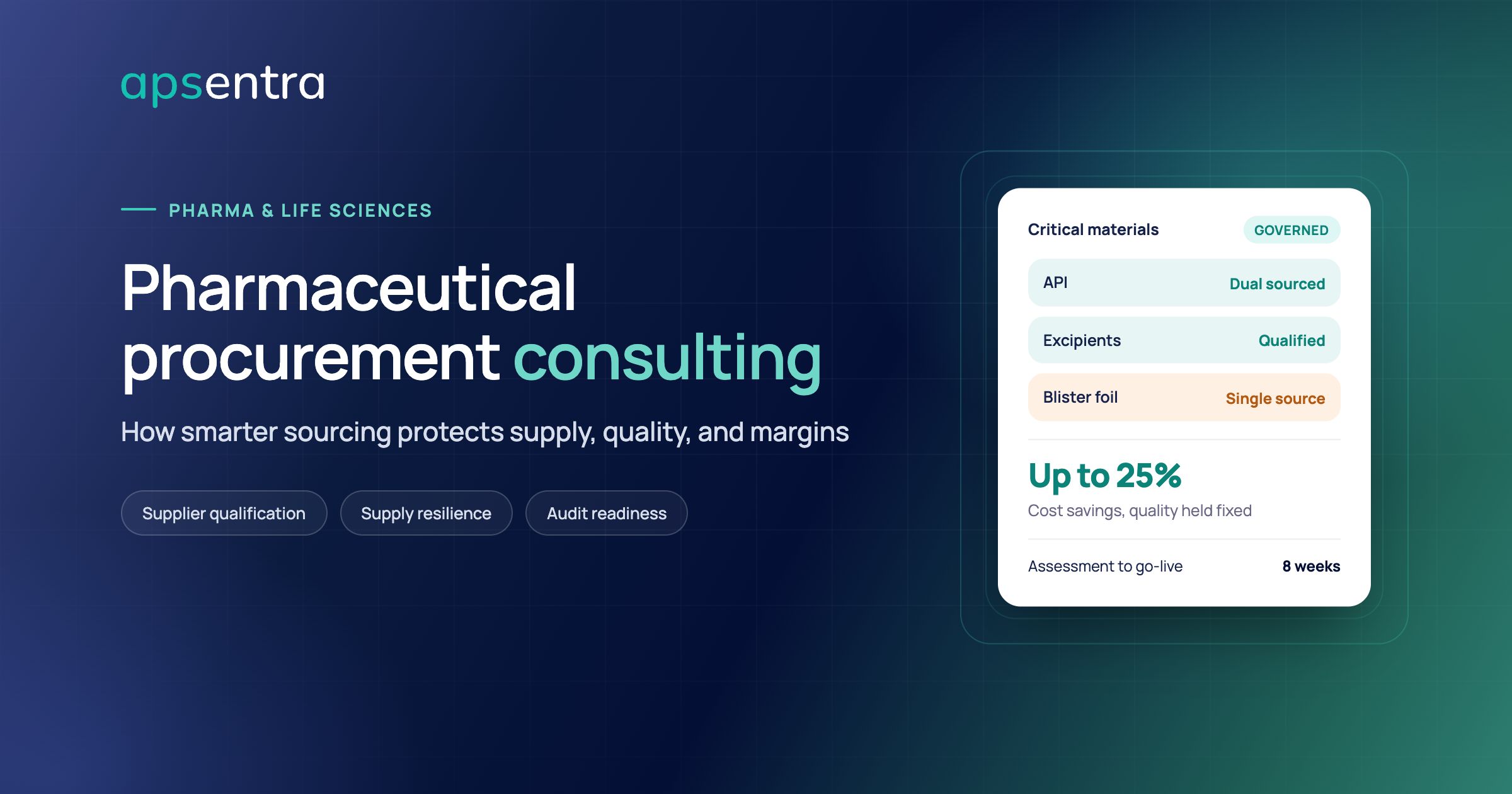
According to APSentra, organizations using the platform typically achieve up to 25% cost savings, up to 80% faster procurement processes, and 100% transparency and control across procurement operations.
From Assessment to Go-Live in About 8 Weeks
APSentra’s implementation follows a structured, consulting-led approach:
- Consulting (1 week): review existing processes, define goals and KPIs, and identify savings potential.
- Implementation and automation (3 weeks): configure the platform, launch workflows, and begin tracking procurement KPIs.
- Integration (3 weeks): connect APSentra with ERP, accounting, and analytics systems.
- Learning (1 week): train teams through certified courses and practical use cases.
- Control and optimization (ongoing): monitor performance and continuously improve.
Key KPIs for Pharmaceutical Procurement
Measuring the right things keeps a transformation on track. These indicators are especially relevant in pharma:
| KPI | Why it matters in pharma |
|---|---|
| Spend under management | Shows how much spending follows governed procurement processes |
| Verified cost savings | Proves bottom-line impact against an agreed baseline |
| Supplier on-time, in-full (OTIF) rate | Protects production schedules and product availability |
| Supplier quality and defect rate | Links directly to product quality and compliance |
| Share of critical materials with qualified backup suppliers | Measures resilience against supply disruption |
| Supplier concentration by country or site | Highlights geographic and geopolitical risk |
| Contract compliance | Shows whether negotiated terms are actually used |
| Off-contract (maverick) spend | Tracks purchasing outside approved suppliers and processes |
| Procurement cycle time | Measures speed from request to purchase order |
| Audit readiness | Reflects how quickly complete purchasing documentation can be produced |
How to Choose a Pharmaceutical Procurement Consulting Partner
When evaluating potential partners, ask:
- Do they understand regulated industries? Look for experience with GMP environments, supplier qualification, change control, and pharma-specific timelines.
- Can they balance cost with quality and supply security? Avoid partners who focus only on headline price reductions.
- Do they use data? Recommendations should be based on a clear spend baseline and measurable targets.
- Do they offer technology, not just reports? Ask how their recommendations will be enforced after the engagement ends.
- Will they support implementation? The hardest part of transformation is rollout and adoption, not the strategy document.
- Can they show relevant results? Ask for case studies from pharmaceutical, healthcare, or similarly complex, high-volume environments.
Partners like APSentra, which combine procurement expertise with a platform that operationalizes the strategy, are well placed to deliver improvements that last.
Conclusion
Every medicine that reaches a patient depends on a supply chain built from thousands of purchasing decisions. In pharmaceuticals, those decisions must protect quality, satisfy regulators, secure continuity of supply, and control costs, all at once.
Pharmaceutical procurement consulting helps organizations find that balance. It builds a clear picture of spending, identifies supply risks, designs category and supplier strategies, and sets strong governance. But strategy only delivers lasting value when it’s embedded in the way the organization buys every day.
APSentra brings the two together: procurement expertise to define the right approach, and an AI-driven source-to-pay platform to enforce it through centralized spend visibility, supplier management, digital sourcing, approval workflows, contract control, and audit-ready compliance. For pharmaceutical manufacturers, distributors, and healthcare organizations ready to move beyond spreadsheets and email approvals, APSentra offers a free demo and a savings calculator on its website.
Frequently Asked Questions
What does a pharmaceutical procurement consultant do?
A pharmaceutical procurement consultant helps pharma and healthcare organizations improve how they buy goods and services. This includes spend analysis, supplier qualification and risk management, sourcing strategy, contract negotiation, governance design, and implementing technology to sustain improvements.
Why is procurement so important in the pharmaceutical industry?
Procurement decisions affect product quality, regulatory compliance, supply continuity, and cost. A problem with a critical supplier can delay production or contribute to medicine shortages, so procurement is as much about risk management as cost reduction.
Can pharmaceutical companies reduce procurement costs without affecting quality?
Yes. The key is using total cost of ownership rather than unit price, prioritizing savings in lower-risk categories such as indirect spend, consolidating fragmented purchasing, and running transparent competitive sourcing where appropriate, while keeping quality and supplier qualification as fixed requirements.
What is the difference between direct and indirect spend in pharma?
Direct spend covers materials and services used to make products, such as APIs, excipients, packaging, and contract manufacturing. Indirect spend covers everything needed to run the business, such as IT, facilities, laboratory supplies, logistics, and professional services.
How does procurement software help pharmaceutical companies?
Procurement software centralizes spend data, supplier information, sourcing, contracts, and approvals in one system. Platforms like APSentra enforce purchasing policies automatically and create complete audit trails, helping organizations stay compliant, control costs, and sustain the results of consulting projects.
Does APSentra integrate with existing pharmaceutical ERP systems?
Yes. APSentra is ERP-agnostic and integrates with systems including SAP, Oracle, Microsoft Dynamics, NetSuite, QuickBooks, and Odoo, so organizations can improve procurement governance without replacing their core infrastructure.